Introduction to Editorial Skills: Copy-Editing and Proofreading
Introduction to Editorial Skills offers new editors the chance to learn proofreading and copy-editing skills.
You will be given expert editorial advice and the opportunity to practise the key skills of the proofreader and copy-editor across a range of different types of content, for both print and digital output.
The course content is regularly revised and updated, to ensure that it stays on top of current trends and systems in publishing. The three tutors are all well-respected editors in the industry with a wealth of experience.
Once you have taken this course, you will have the foundations on which to build a successful editorial career.
Who is it for?
Individuals working in book or journal publishing, in-house or freelance, wishing to develop copy-editing and proofreading skills; anyone who has to proofread or copy-edit as part of their job; and students keen to start a publishing career and gain formal skills. These include:
- assistant editors
- copy-editors
- desk editors
- editorial assistants
- production editors.
What will you achieve?
On completing this course you will:
- have a clear sense of what you are trying to achieve when editing or proofreading a document
- understand your editorial responsibilities
- see how your role fits in with others involved in the publication process
- comprehend the substance of, and differences between, copy-editing and proofreading.
Programme
The course promotes active learning through a blended approach of self-study and three online group sessions. You will learn through a range of short and longer exercises, on-screen and offline completed independently or in small-groups, supported by group discussion and expert guidance and feedback from our highly experienced PTC tutors.
Copy-Editing
You will learn to identify and fix:
- Poor structure
- Ambiguity
- Repetition and redundancy
- Poor grammar or punctuation
- Inappropriate or non-inclusive language
You will also learn:
- Why consistency is important
- What editorial conventions, house style and job-specific style are, and why they matter
- How to make and record their own style decisions
- How to approach copy-editing methodically and strategically
- How to follow a brief
- Where to to turn for further help and guidance
Proofreading
You will also learn how to proofread effectively:
- Layering
- Slow reading
- Judging how much to change
- Marking proofs clearly and efficiently with BSI and PDF mark-up
- Distinguishing editorial corrections, layout and queries
- Where to turn for further advice on BSI and PDF mark-up
How the course is delivered
The course consists of 6 x 2¼-hour sessions including breaks, each a mixture of delivery and interaction using Zoom breakout rooms and other online tools. There will be a 45-minute exercise set to complete between the sessions, and a 45-minute break. The course will run on from 9.30am to 2.00pm on each day.
You will need access to a computer or laptop with a camera and microphone and with Microsoft Word and either Adobe Acrobat Reader DC (which is free) or Adobe Acrobat Professional installed. To join the course, you will need to activate a Zoom account. This takes 2 minutes and does not require any payment. It is purely for administrative purposes.
Any information to be completed beforehand will be sent via email.
Accessibility
Please contact us at with any accessibility or special requirements, for example having in-session captions or the learning materials sent to you in advance.
If you have any concerns about technical requirements or access please contact us on or telephone +44 (0)20 8874 2718.
In-company training
This course is also available for in-company training, either virtually or in person at your office. Course content is tailored to suit your requirements. Group sizes range from 5 to 12 attendees. To find out more, email or telephone +44 (0)20 8874 2718
Delegate feedback
"I have immediately gained a very good understanding of the copy-editing and proofing process and how they relate to each other. I definitely enjoyed the course. The tutor was clearly very dedicated to this subject, had a wealth of experience, and made sure we all engaged fully with the course." Communications and Publications Manager, The Police Foundation
"Caroline Knight was the most brilliant instructor. The course was delivered in an engaging and easy-to-follow way, with the opportunity to ask questions throughout. The tasks and the open discussion that followed were incredibly helpful. I am much more confident in copy-editing and proofreading copy myself now and have a solid grounding in the technical processes and language of both. The course was wonderful and I would recommend it to anyone working in editorial." Elliott & Thompson Delegate
"I loved the course. I've gained so many immediate benefits from this course. I now have more confidence in my approach to copy-editing in every single way. Caroline Knight was a brilliant tutor. So engaging and so experienced! There was a great array of activities to practise skills and I loved Caroline’s questioning technique, making sure everybody contributed and understood. It also kept me alert!" Chartered College of Teaching Delegate
“It was such thorough training, I really enjoyed it! I learnt so much about copy-editing and proofreading, and Sarah was very patient with our questions and answered fully. She broke things down in a really good way, and the exercises she gave us helped strengthen our skills.” Oxford University Press delegate (in-company training)
“The course leader was highly knowledgeable and engaging, giving all delegates equal time to ask questions and share their own insights. I have a deeper understanding of copy-editing, proofreading, formatting and marking up editorial projects.” Geographical Association delegate
“Caroline Knight is brilliant! She was engaging, fun and supportive at every stage. She has a wealth of knowledge and experience, and it was a privilege to be taught by someone who shared it so generously. This course was an excellent introduction to copy-editing and proofreading. It was super helpful to learn how texts are edited and typeset before they reach the production stage, and how complex the book publishing process can be. I’ve gained knowledge and skills to apply immediately in my current role.” Production Assistant, Bloomsbury Publishing
"The course was well-organised, useful and lively. The teacher was extremely competent and clear, and addressed all the questions. I gained a great overview on the main tasks of copy-editors, an understanding of consistency rules and editorial conventions, and many useful aspects of Word formatting and PDF mark-up.” Federation of European Biochemical Societies delegate
“The course was informative and I learned a lot. Caroline Drake explained the concepts clearly, providing helpful examples when necessary. The exercises were useful and I especially liked that we learned both practical editorial skills and the more subtle skills, such as how to best phrase author queries." Editorial Assistant, Walker Books
About the tutor(s)
One tutor will deliver all three sessions of a course.
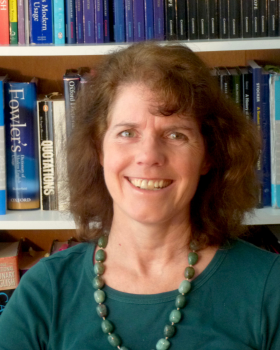
In an in-house career that took her to Berlin, London, Oxford and Cambridge, Caroline Drake worked on a wide range of academic books, journals and illustrated trade titles. She was trained at Blackwell and Cambridge University Press, where, as senior subeditor then copy-editorial manager, she in turn trained copy-editors and proofreaders for fifteen years. She updated Butcher’s Copy-editing, with a colleague, for the fourth edition.
Now freelance, Caroline enjoys helping authors to get things right, first time. She has created and taught courses for a variety of clients, including publishers, educational organisations, the CIEP (formerly the SfEP), the reporters of the Scottish Parliament and the Parliamentary Research Service at the House of Commons.

Since 1999, Sarah Sodhi has proofed, tagged, bound, corrected, edited, managed, commissioned, subbed, scheduled, estimated and produced a great deal of content – from interactive, multi-media resources to marketing leaflets, from monthly magazines to 900-page medical tomes.
Starting her career at a small medical publisher in Oxford, Sarah produced medical textbooks, journals and a bi-monthly magazine. She then moved into the public sector to work for an adult education charity, introducing formal scheduling procedures, progress-chasing systems and detailed budgets. After this, she immersed herself in the education sector, editing and managing digital and print resources for primary, secondary and adult education publishers.

Caroline Knight has spent her career in publishing, working both in-house and freelance. She held senior editorial roles at Penguin Books, Weidenfeld & Nicolson Illustrated, William Heinemann (an imprint of Random House) and Atlantic Books; since 2010, she has been a freelance structural and copy-editor alongside tutoring for PTC.
Related courses
The PTC offers virtual classroom courses, self-study distance-learning courses, and a range of e-learning modules. See below for those that complement or build on this course.
Virtual Classroom Courses
- Applying AI – Tools, Ethics and First Practical Steps
- Copyright – the Basics
- Editorial Project Management
- The Fundamentals of Public Speaking
- Grammar and Punctuation – the Basics
- How to Mark Up PDFs with Adobe Acrobat
- Line-Editing Workshop (Fiction or Non-Fiction)
- Making Sense of Grammar
- Making Sense of Punctuation
- Progress in Editorial Skills
- Working with Authors
e-Learning Modules
- A Comprehensive Guide to Copy-Editing
- A Copy-Editor's Guide to Working with Authors
- An Editor's Guide to Author Queries
- An Editor's Guide to Editing Fiction
- An Editor's Guide to Editing Illustrations
- An Editor's Guide to Editing References
- An Editor's Guide to Editorial Style
- An Editor's Guide to Working with Typesetters
- An Introduction to Proofreading
- An Introduction to Publishing
- Essential Copyright for Publishers
- Essential Editorial Project Management
- Proofreading PDFs: A Complete Guide for Editors
For more information about any of these courses, please email or sign up to receive our newsletter for updates on these and our other offerings.
Please read our Terms & Conditions
Course format
- Virtual classroom
- 9.30am to 2.00pm
- 6 x 2¼-hour sessions including breaks, comprising 3 long half-day sessions on 3 days
Date information for future sessions
March 2026
- Dates: 2, 4 & 6 March
- Times: Each session will run from 9.30am to 2.00pm
- Tutor: Caroline Drake
May 2026
- Dates: 11, 13 & 15 May
- Times: Each session will run from 9.30am to 2.00pm
- Tutor: Sarah Sodhi
June 2026
- Dates: 15, 17 & 19 June
- Times: Each session will run from 9.30am to 2.00pm
- Tutor: Caroline Drake
July 2026
- Dates: 6, 8, & 10 July
- Times: Each session will run from 9.30am to 2.00pm
- Tutor: Sarah Sodhi
September 2026
- Dates: 7, 9 & 11 September
- Times: Each session will run from 9.30am to 2.00pm
- Tutor: Caroline Drake
October 2026
- Dates: 12, 14 & 16 October
- Times: Each session will run from 9.30am to 2.00pm
- Tutor: Caroline Knight
November 2026
- Dates: 9, 11 & 13 November
- Times: Each session will run from 9.30am to 2.00pm
- Tutor: Sarah Sodhi
What you will need
You will need access to a computer or laptop with a camera and microphone and with Microsoft Word and either Adobe Acrobat Reader DC (which is free) or Adobe Acrobat Professional installed. Please check that you have the latest version of Adobe Acrobat Reader.
To join the course, you will need to activate a Zoom account. This takes 2 minutes and does not require any payment. It is purely for administrative purposes.