Sustainability in Publishing – advice from the webinar

Sustainability in Publishing – advice from the webinar

On 25 September, sustainability expert Simon Crump led a webinar for the PTC. This Comment picks out key advice on how to be more sustainable, with links to helpful resources.

How can you start your sustainability journey?

Some say that it costs more to be sustainable, but that is not necessarily true. As an organisation, you can do simple things, like replacing your lights with LEDs, recycling more and better, or changing your electricity to a greener supplier.

Find a champion in your organisation, who cares about the issue and can encourage others to act. You will need buy-in from senior management to make any changes work.

Materials

  • Paper is not just about using recycled paper. Simon used an example of a book about sustainability, with no cover lamination, printed on paper using fibre from sugar beet. The paper is a bit rough, with flecks in it, but it suits the title. You need to research materials, talk to your printer, or ask them to talk to suppliers. Find a different paper with similar opacity and brightness, but a lower carbon footprint, for example.
  • Laminate protects your book and could last 30 years, but it cannot be recycled. Laminate makers are now making thinner versions with the same strength and properties, with 20−23% less plastic in them. Try to source these.
  • Vegetable inks may not be the best print quality, but this may not matter. If you are printing a mono book for general reading, then they could be fine. But if you are producing a high-quality, museum catalogue with images, for instance, then they may not work.
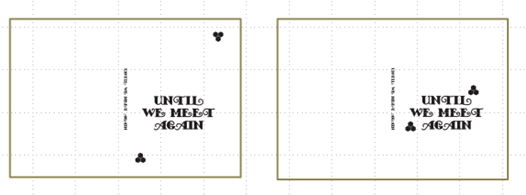
  • Design is important when thinking about sustainability. In the images below, the one on the left wastes 70% of the foil used, the image on the right only 17%. Talk to your designers and printers about what makes a difference, where can you make changes.

  • Think about trim sizes. Are they most economical for the printer's presses? Or are you wasting paper because large amounts are trimmed and thrown away?
  • Can you remove or reduce blanks at the back of a book?
  • If you have an index, think about reducing its font size to save pages.
  • What fonts are you using? Times New Roman takes up a lot of space on a page, whereas Bembo and Garamond are smaller fonts, with a smaller ‘x’ height, using less of the page.

Sustainable printing practices

A distributed print model uses printers around the world. For instance, a printer in the UK prints books for the UK market, whilst a US printer does another quantity for the US market. There are no shipping costs, and the books are in the warehouse at the same time. For copies in other regions, you could use print-on-demand (POD).

With ‘zero-inventory’ or ‘short-run’ models, once a book’s stock in the warehouse falls below a certain number, the warehouse automatically sends an order to the printer for a reprint to be delivered into the warehouse.

POD is a delivery strategy. Its print unit cost might be higher, but the book is only printed when somebody orders it. Printing might cost more, but there is no charge for storage or handling.

Physical books versus ebooks

No one can say whether print or ebooks have a lower carbon footprint. Ebooks sit on servers, with their associated carbon-dioxide equivalent (CO2e), which is hard to calculate. Each time you download an ebook, its carbon footprint increases. If you read a book on a tablet or phone, then its carbon footprint is shared with other activities on that device. But if it is on an e-reader, then the carbon used in making the device goes against ebooks.

AI and sustainability

AI can be a great help, but it is greedy in terms of energy use. One ChatGPT query uses 0.34 watts of energy. With 1 billion queries per day, this equals 340,000 kilowatts, or 124 gigawatts annually. 124 gigawatts per hour is equivalent to powering London for 10 days.

Adding in support to run ChatGPT – a factor of 10 – makes 1,240 gigawatts annually.

European Union Deforestation Regulation (EUDR)

EUDR is about traceability, to ensure that the trees that made a book’s paper are not causing deforestation or land degradation. Book Industry Communication (BIC)’s fast-track project aims to provide practical solutions to delivering EUDR across the book industry. You can see the results here.

Although there is a move to delay its implementation from December 2025, publishers need to think about the changes they need to make to systems and processes to be able to implement and run EUDR.


Simon Crump


Simon Crump is a Publishing Consultant and sustainability expert.

He is Environmental Consultant at Book Industry Communication (BIC) Ltd, where he sits on the Green Supply Chain Committee; General Manager at the British Printing Industries Federation (BPIF); and a Senior Associate at Maverick Publishing Specialists.


Useful links and resources


2025

Read more: Sustainability in Publishing – advice from the webinar

Be Curious, Not Just Bookish: Why Publishing Professionals Need to Stay Engaged with Their Industry

Be Curious, Not Just Bookish: Why Publishing Professionals Need to Stay Engaged with Their Industry

In the publishing industry, we work with ideas, stories and knowledge every day. Yet how often do we stop to think about our own knowledge – about the industry we’re in? It’s a strange contradiction: we spend our days making content discoverable, yet we don’t always make time to discover what’s shaping our own sector.

When I teach Book Marketing & Sales at the University of Sydney, I devote the final class to looking ahead – exploring trends, challenges and possibilities in sales, marketing and publicity. We talk about workflow tools, the role of AI (even the controversial bits), and the changing nature of discoverability. But each week I also encourage students to pay attention – to follow industry news, subscribe to publishing newsletters, attend events and festivals, and take an interest in how our ecosystem functions. Curiosity may not be part of your job description, but it should be part of your professional practice.

Let’s be honest: publishing can be intense. You’re juggling deadlines, last-minute changes, elusive authors, metadata dramas and shipping delays. But if you’re only focused on your to-do list, you miss the bigger picture – and the chance to connect more deeply with your work and the people around you.

As Ted Lasso (quoting Walt Whitman) wisely said, “Be curious, not judgemental”. Curiosity is one of the best tools we have for long-term career satisfaction. It helps us build context, stay relevant, and – let’s not forget – have more interesting conversations that go beyond who’s on the bestseller list this week.

The case for awareness

Ask yourself: when was the last time you read an article about publishing that wasn’t directly related to your role? Have you explored the challenges distributors are facing right now? How they’re managing sustainability or supply-chain issues? What’s happening in rights and licensing? How’re publishers experimenting with formats or marketing channels?

These aren’t niche concerns. They shape the business decisions that underpin every part of our industry. If you’re a production editor, understanding how metadata flows through distribution systems will give you insight into how books are discovered – or overlooked. If you’re in marketing, a working knowledge of what booksellers need (and why it matters) makes you a better partner to sales teams. If you're in editorial, knowing the latest consumer reading trends helps position your titles more effectively.

No matter where you sit, understanding how the puzzle pieces fit together makes you better at your job.

Don’t be buried in a book

It sounds strange in our line of work, but some publishing professionals are a little too focused on books. We love them, of course – but our job isn’t just to work on books. It’s to understand readers, audiences and markets.

And yet, some of us haven’t joined our local library or been to a book event in years. How can we claim to work in a reading culture if we don’t participate in it?

Even casual engagement with book culture – via libraries, bookshops or social-media trends – helps us understand what’s working and what’s shifting.

Metadata matters (yes, even to you)

Metadata is the hidden infrastructure of book marketing and sales. It’s how readers, booksellers and librarians find your book.

You don’t need to memorise ONIX codes, but you should understand why clean, timely data matters. Ask your sales team how often they’ve dealt with missing publication dates or broken links.

Good metadata supports good marketing. It’s not exciting, but it’s essential.

How are you leading?

What do people come to you for? That’s your leadership zone. Own it. Share it.

You don’t need a formal title to lead. Sometimes it’s as simple as sharing a great article or helping colleagues think beyond their task list. Leadership can be about awareness and encouragement just as much as direction.

Celebrate what you know – and what you can learn

We spend a lot of time in publishing celebrating books, authors and award lists – and, yes, indulging in a bit of gossip. But we don’t always celebrate our own contributions or professional growth.

It’s refreshing to talk about industry developments instead of office politics. It’s energising to connect over a shared interest in how publishing is evolving. And it’s inspiring when someone new to the industry asks a big question – not because they don’t know the answer, but because they want to know.

So, if you’re new to publishing: welcome. Subscribe to industry newsletters like BookBrunch (UK), Books+Publishing (Australia), The Bookseller (UK) and Publishers Weekly (US). Follow local publishers and authors on LinkedIn or Instagram. Join your local library.

If you’ve been around for a while: share what you know and invite others into the conversation. Be the person who sparks curiosity.

After all, we’re in the business of ideas. Let’s not forget to have some of our own.


Rachael McDiarmid


Rachael McDiarmid is a lecturer in Book Marketing & Sales at the University of Sydney, Australia. She runs her own consultancy, RM Marketing Services, and has over 30 years’ experience of working in publishing. Follow her on LinkedIn.


2025

Read more: Be Curious, Not Just Bookish: Why Publishing Professionals Need to Stay Engaged with Their Industry

How to Harness AI in Publishing – an Overview

How to Harness AI in Publishing – an Overview

The PTC’s webinar on 25 June discussed how publishers can navigate the latest developments in generative artificial intelligence (AI). Three expert panellists explained what’s happening in marketing, new-product development and the legal side of AI.

We’ve highlighted key insights below.

Winning the book-marketing game with AI

Book marketing can be tough, explained Brooke Dobson, Co-Founder and Chief Commercial Officer of Shimmr AI, with media fragmentation, diminishing attention and marketing waste that low-margin books can’t sustain. Adopting an AI-first mindset can help overcome these challenges – by using it for research and strategy, creative ideation, asset production, testing and optimisation, metadata and search-engine optimisation.

For most publishing workflows, Claude (Anthropic), Gemini (Google) and ChatGPT (Open AI) are the most reliable.

💡Top tip: Use AI to automate the tasks you dread and to enhance those you like. Experiment with as many tools as possible.

How to work with an AI

    • Start simple, using a conversational tone
    • Give context and describe your needs clearly
    • Be specific – detail your audience, purpose and desired outcome
    • Guide with chain-of-thought instructions to clarify complex tasks
    • Request 50 ideas, not 5, and push it to elaborate on promising concepts

Brooke suggests these time-saving tools:

▶️ Otter for transcription

▶️ Intercom for customer support

▶️ Gamma to create presentations

▶️ Veed to make videos.

To inject more creativity into your marketing, try:

▶️ Flux to create storyboards and ads

▶️ Hailuo for animations

▶️ ChatGPT/DeepSeek to create drafts, blurbs, metadata and emails.

💡Top tip: Choose the right model for your purpose – whether fast, powerful or specialist – and disable the training option for privacy.

Win on Amazon with AI

Amazon’s A10 algorithm prioritises external traffic and rewards relevance, trust and sustained reader satisfaction. AI gives you the tools to deliver these – faster, smarter and at scale.

Sustainability

Brooke advised contributing to sustainability by using low-energy models, equivalence metrics – such as comparison with car mileage – or more balanced technologies.

How to create trusted, safe pedagogical AI solutions

Eirik Wahlstrøm, Co-founder and CEO of Ludenso, began with a quick poll, showing that many of us use AI once a week or more. He highlighted that AI now creates more internet content than humans, and that it’s tricky to distinguish between the two. How can we trust what we see and hear? Navigating the AI landscape isn’t easy and publishers have big challenges to tackle, including:

    • ensuring accuracy and quality
    • safeguarding Intellectual Property (IP) rights
    • build or buy?
    • choosing the right AI models
    • reskilling and upskilling
    • meeting elevated customer expectations.

How to build accuracy and trust

Publishers can be the trusted option for pedagogical AI use with Retrieval Augmented Generation (RAG), a technique that optimises the output of large language models (LLMs) by integrating them with external knowledge sources. Ludenso’s LAIA is one of several RAG models – including NoteBook LM (Google), Custom GPTs (Open AI) and Haystack (Deepset). The LAIA AI assistant shows how a RAG model can deliver validated, trusted, accurate content to match your audience’s needs and deliver a personalised, branded experience. For example, it can offer:

    • students tailored exams, homework or in-class questions
    • editors generation of multiple-choice questions, lesson plans or PowerPoint presentations.

The AI assistant can be tuned for age level, subject area, grade level, curricula goals, tone of voice and language. You can add features such as quizzes, flashcards and concept explanations, plus ‘Socratic’ modes versus giving away the answers. Data is secured locally with LLM plug-ins.

To get started, Eirik recommends these simple steps:

    1. Test several different models and variants, and ensure they are not being used as a training model.
    2. Make sure you’re not giving away IP in the process.
    3. Share your findings with peers and build confidence.

💡Top tip: Ensure AI applications are validated and include humans in the loop.

How to protect copyright in the age of AI

Copyright and AI is complex, as Leslie Lansman, Head of Permissions & Licensing at Springer Nature and Chair of the Public Policy Committee, the Association of Learned and Professional Society Publishers (ALPSP), explained.

Leslie’s list of (non-exhaustive) considerations will help you choose the right AI tool.

She advises that you carefully examine any terms, conditions or other requirements in accessing or using an AI system. Understand how the tool works and what happens to your material if you stop using it.

    • Create policies and training on how to use your AI tools. Establish rules and/or technical solutions to ensure data privacy, confidentiality and copyright compliance.
    • Understand the security and resilience of your AI tools.
    • Use content in the public domain or under appropriate licence. Questions remain on how best to deal with the attribution requirement if using Creative Commons BY material.
    • Avoid using protected works, copy/pasting or describing styles, images or logos. See Copyright Licensing Agency AI Licences for AI workplace licences that allow limited reuse of participating publishers’ works in some internal AI systems.
    • Identify the purpose and scope of your AI usage. Add your unique touch. Ensure a human is thoroughly reviewing and verifying any output.
    • Address to what extent you will disclose AI use. Explain what AI you used and how.
    • Document your AI usage and monitor for compliance. Evaluate the AI tools.
    • Think about sustainability!


Brooke Dobson

Brooke Dobson is Co-Founder and Chief Commercial Officer at Shimmr AI (Philadelphia, USA). Follow her on LinkedIn.


Eirik Wahlstrøm

Eirik Wahlstrøm is Co-founder and CEO at Ludenso (Oslo, Norway). Follow him on LinkedIn.


Leslie Lansman

Leslie Lansman is Head of Permissions & Licensing at Springer Nature, Chair Public Policy Committee at ALPSP (London, UK). Follow her on LinkedIn.


2025

Read more: How to Harness AI in Publishing – an Overview

Copywriting in the Age of AI

Copywriting in the Age of AI 

You’ve probably never forgotten the thrill of the first time you asked a generative artificial-intelligence (AI) program to write something for you. Words appearing on screen more quickly than you could have typed them, let alone thought of them.

So does that mean copywriting is a task we can hand over to AI? 

Not yet, no. Maybe not ever. There are definitely uses for it, though, and ways it can help us be better, more efficient writers.

Why AI isn’t a copywriter 

As you’ve no doubt discovered, the words you get as an AI output don’t always stand up to scrutiny. The argument or narrative might not run very smoothly or convincingly. It might not get the right message across. It might feel a bit overwritten or hyperbolic. It might be longer than it needs to be. It might sound a bit stilted and impersonal. 

The same, of course, is often true of the first draft humans write too.

Why is that?

It’s because the hard bit about writing isn’t typing the words, it’s the thinking that leads to them. What do you want to say? How do you want to say it? Why do you want to say it? Where does it fit in with the other things you’re saying at the moment? Who are you saying it to? How do you want readers to feel when they finish reading? 

Some people try to circumvent the bad first draft by writing detailed outlines before they start. But even that’s no guard against discovering the gaps in your argument as you start to draft (I speak from bitter experience!). Others prefer to write the ‘ugly first draft’ then edit and polish it afterwards. Whichever your preferred method, you have to go through the thinking process to get to anything good. 

And something good (rather than ‘good enough’) is important. Good copy isn’t about words that sound nice. It’s about words that sell. It’s why copywriting is referred to as ‘salesmanship in print’. 

The fact that AI isn’t – yet – doing the thinking that’s central to effective copy is one of the reasons its output often doesn't stand up to scrutiny. It's why you can’t – yet – entirely outsource copywriting to a machine.

It doesn’t mean you can’t use AI to help you write copy, though. Because there are lots of ways it can help you be a more efficient copywriter.

AI copywriting use cases 

AI is useful when you’re researching a particular field or market. It can distil hours of Googling into a pithy summary. However, don’t automatically believe everything you read.

If you aren’t familiar with the area you’re researching, take time to sense check what it tells you. Ask it for sources and verify those sources for credibility and accuracy.

If you are familiar with the area you’re researching, take unexpected findings with a pinch of salt until you’ve checked them out yourself. 

AI has value when brainstorming – headlines, subject lines, outlines and more. It can take away the fear of the blank page and help kick-start your thinking.

Use AI to critique your work too. In the same way as you’d ask a colleague, you can ask an AI to do the same. But again, don’t automatically accept its feedback – use your critical-thinking skills to assess its value and accuracy. 

It’s useful for basic proofreading, but it isn’t infallible.

You can also use AI to repurpose your work – create social-media posts from articles you’ve written, turn text written for print into web-friendly words, swap one copywriting framework for another. It’ll give you a great starting point to work from. 

What do all these use-case suggestions have in common? 

It’s here that we get to the really interesting point about AI. You’ll notice that in all those examples, I’ve suggested you check what the AI gives you. 

And to do that, you need to know what you’re checking and why. 

I’m fortunate. I’ve got nearly 30 years’ professional experience behind me. I’ve spent 30 years learning, thinking and applying copywriting frameworks the long way, without the aid of AI. It gives me a huge advantage now because I’m equipped to critique an AI’s output, in the same way as a manager would have critiqued my work when I was starting out.

It’s why, if you’re tasked with writing copy for your organisation, it’s vital to learn the skills of good copywriting for yourself. When you understand the rules, you can be the manager of AI rather than vice versa. You’ll be equipped to turn your copy (whether you’ve written it yourself or asked an AI for help) from basic to brilliant. You’ll be able to give better prompts and get better outputs. You’ll have all the tools you need to ensure your words translate into sales. Most importantly, you’ll gain the vital thinking skills that will make you more valuable – and more employable – as you progress in your career. 


Catherine Every


Catherine Every is a freelance copywriter and writing skills trainer. She tutors Copywriting for Publishers for the PTC. Follow her on LinkedIn


2025

Read more: Copywriting in the Age of AI

Seven Insights from Teaching Content Design and Content Strategy

Seven Insights from Teaching Content Design and Content Strategy

Since 2000, I’ve been running web content design and strategy courses for The Publishing Training Centre.

Over the years, I’ve trained around 2,500 people from all over the world and in all kinds of sectors: publishing and other businesses, government, non-governmental and international organisations.

Here are seven insights I’ve gained:

1. Everyone brings unique skills

Learners come from diverse backgrounds, including marketing, editing, design and technical roles, bringing unique skills to the courses.

They may lean towards organising content or workflow, or paying attention to detail.

They could be confident about writing in plain English, but not structuring multi-channel content. Or they could understand their organisation’s brand tone and voice, but not the terminology that their customers use.

Whether you are a career changer or want to develop your existing strengths, taking a course will build your confidence, and help you transition successfully into content roles.

2. Broken systems lead to poor content

Ineffective systems often lead to poor content. Publishing staff face a variety of challenges – including workarounds, lost time, inefficient workflows, manual processes that delay content updates, fragmented systems hindering team collaboration, and workflows that don’t align with content goals.

Recognising these issues is often the first step toward change.

3. Beware the ‘curse of knowledge’

The curse of knowledge is a cognitive bias where someone who knows something assumes others also understand it at the same level.

I continue to underestimate how mind-blowing these content-design and content-strategy concepts can be:

  • how to start with user needs, not what you want to publish, to pull in your audience and make them the main focus
  • the inverted-pyramid style of writing
  • the F-pattern of reading
  • how to advocate for plain language.

When you’ve been working in a field or for a particular organisation for a while, you too may have the ‘curse of knowledge’. Learning the right techniques will help you to break this curse and consider your audience’s perspective, get closer to what your readers need, and not publish what you think they need!

4. Digital publishing has changed, not always for the better

When I began training, the technology was difficult to use. You had to be a bit of a geek to work in web content!

Although publishing tools are now more accessible, this has brought new challenges.

The proliferation of platforms and the constant demand for fresh content often lead to rushed outputs, poorly aligned strategies and diminished quality.

Knowing where your customers are and what they need is more critical than ever to avoid wasting resources on the wrong content in the wrong place, in the wrong format.

Standards must adapt to technology, but some fundamentals have remained timeless – like understanding your audience and crafting messages that meet their needs. By mastering the right techniques, you will better understand what your users require and write content that resonates with them.

5. Not all new ‘shiny things’ are useful

The fundamental principles of content design and content strategy have remained constant, but the tools, techniques and best practices have evolved significantly.

I’ve seen many trends come and go: animating slideshows on home pages, flashing text, inaccessible content, spinning logos, apps and now artificial intelligence (AI).

We must keep in mind our guiding principles when new tech comes along. Which new development or technology improves productivity and is useful to your users and your organisation?

We need to continually improve our ways of working. This includes being aware of how we can make new tech work for us. For example, right now we need to get AI in perspective. It offers both opportunities and challenges to content designers and strategists.

With training, you can adapt to technological advancements without losing sight of foundational principles. It’s important to explore opportunities to integrate innovation while being committed to user needs and organisational goals.

6. Never stop learning and iterating

Feedback is vital. Every training session is a two-way exchange. My courses have changed dramatically since they started over 25 years ago. Many changes have come from participant feedback.

Learning about the current challenges that people working in content face is crucial to continually adapting the courses to keep pace with a rapidly changing content landscape.

7. I’m glad to be part of this smart and generous community!

People make our content design and strategy community. The field thrives on the diversity of ideas, where different perspectives lead to innovative approaches to problem-solving.

Content designers and strategists are constantly curious about what users need and how to meet those needs. They love problem-solving, language, data and evidence. And they are eager to share their experiences and expertise, which makes for an open-minded, supportive, collaborative environment.

Come join us!


Sue Davis


Sue Davis is a content designer and content design trainer. She tutors two PTC courses – Building a Successful Online Content Strategy and Writing for Online Audiences. Follow her on LinkedIn.


2025

Read more: Seven Insights from Teaching Content Design and Content Strategy