AI in Publishing: How to Embrace It, Stay Human and Supercharge Your Skills

AI in Publishing: How to Embrace It, Stay Human and Supercharge Your Skills

If you're working in publishing today, whether as an editor, translator, designer marketer or writer, you've probably wondered how AI (artificial-intelligence) might affect your role. Perhaps you’ve felt a bit uncertain, curious, or even excited about the possibilities.

I understand these feelings. At Ludenso, we partner with leading publishers worldwide. Through these collaborations, we've gained valuable insights into how publishers with varying workflows tackle common challenges and how they approach AI integration differently.

This post is your AI starter pack: it outlines common pitfalls and tools to try, with zero tech skills required. Just bring your curiosity and a bit of courage to experiment.

Why embrace AI?

Publishing moves deliberately and slowly, for better and for worse. This offers a strategic advantage: we can observe how AI is transforming faster-moving fields like software development. A decade ago, programmers built everything from scratch. Today, the most effective programmers integrate AI into their workflow. Not to replace their expertise, but to extend it. A great programmer becomes even better with AI, and is far better equipped to leverage it than someone without their foundational knowledge.

The same goes for publishing. As an editor, writer, or designer with deep domain understanding, you’ll have a competitive edge when applying AI tools. Whether it’s streamlining tasks, or fuelling creative output, AI can elevate the work you're already great at. 

Yet, with all the excitement, there are a few important considerations.

Navigating pitfalls thoughtfully

Research reveals a cautionary note: extensive reliance on AI can dramatically weaken critical thinking. A 2024 Swiss study revealed a significant negative correlation between frequent AI usage and critical-thinking abilities, mediated by increased cognitive offloading. Simply put, the brain becomes lazier and allows the technology to undertake certain tasks, such as remembering telephone numbers.

Like search engines before it, AI can change how we think, not just what we do. Used mindlessly, it can dull critical thinking, as seen with the “Google Effect”, where we forget information but remember how to find it. Staying sharp is key to maintaining the quality your readers count on.

With this in mind, get ready to save time, level up your quality and have some fun while you're at it! 

Practical AI tools to enhance your work

📚 For editors

  • Grammarly: for grammar checks and stylistic improvements
  • ProWritingAid: offers instant feedback on manuscripts, grammar checking and paraphrasing

✍️ For content creators

  • ChatGPT: for brainstorming, outlining, summarising and exploring new ideas
  • Novelcrafter: tools for authors looking for plot ideas and creativity boosts 
  • Jasper: for crafting marketing copy, blog posts and advertising content.
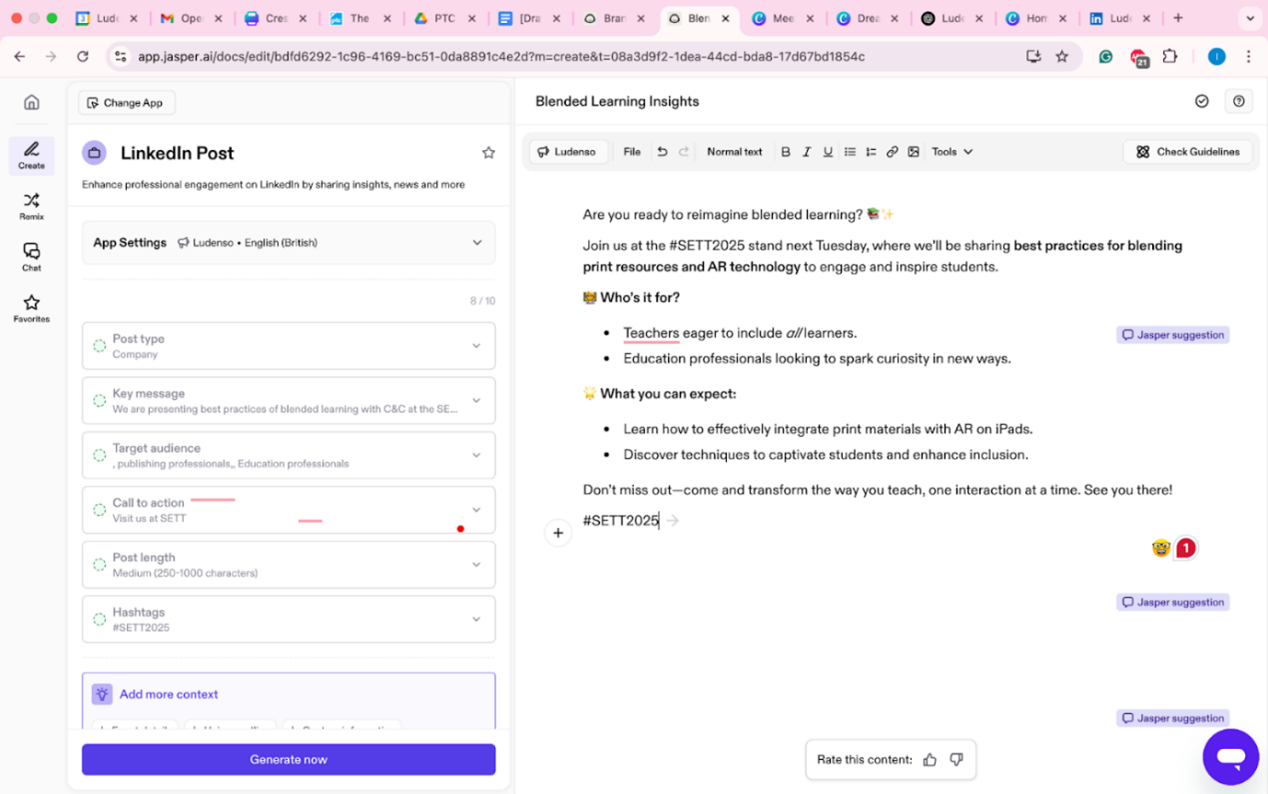
The image above shows how Jasper can generate LinkedIn posts aligned with your brand by setting tone, audience, message and length.

🎨 For designers

  • Canva: helps you to easily create polished visuals
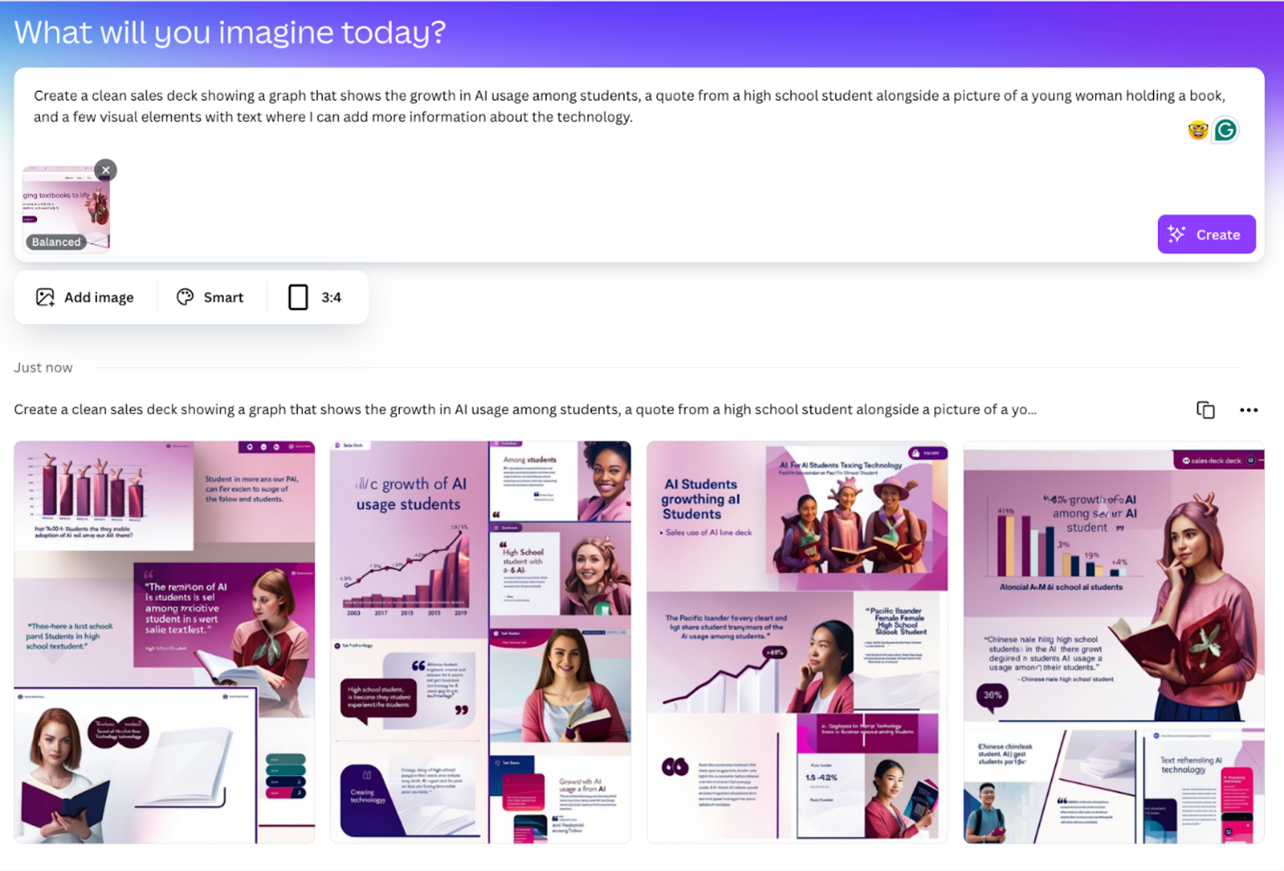
This image shows how a screenshot from Ludenso’s site was used to prompt the AI to create a sales deck as a mood board that can be refined in Canva.
  • Midjourney: for unique illustrations and conceptual art.

🎓 For education use

  • ClearRevise Exam Study Tutor: Ludenso’s AI-powered tutor is embedded in textbooks and tailored to exam specifications. Students can receive page-referenced, curriculum-aligned support
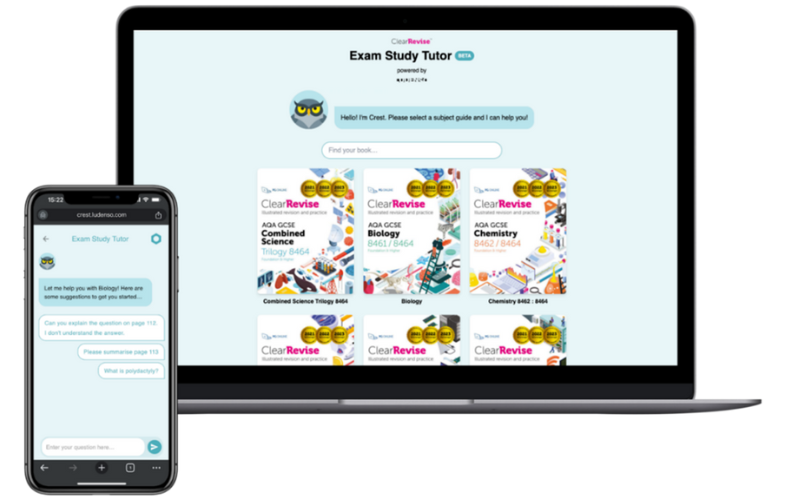
In the picture, students can select a textbook, and then receive instant tutoring.
  • Curipod: helps teachers to create interactive lessons with polls, quizzes and collaborative activities.

Continuously build your AI literacy

The tools above are just a few examples. Some are free with optional upgrades, while others require a paid subscription. There are thousands more available. To find one that fits your needs, head to FutureTools.io and explore by category, for example, “copywriting” or “translation”.

AI literacy isn’t about mastering everything; it’s about staying curious and continuously learning. By building your AI literacy, you're positioning yourself as an invaluable team member.

Stay curious

Ultimately, the best way to address any uncertainty or excitement you might feel about AI is by learning from experts in the field. I highly recommend finding newsletters about your specific area. Some of my favourites are Absolutely Textbook and AIxEducation. Substack is a fantastic place to discover voices tailored to your interests, whether you're curious about AI in Higher Education, or passionate about open-access publishing. Find something you genuinely look forward to receiving in your inbox, and you'll naturally stay informed. And if you like what you just read, consider subscribing to the Letters from Ludenso where I’ll be sharing more from the intersection of publishing and edtech.

By embracing a hands-on approach, you'll confidently navigate the future of publishing, empowered by both AI and your domain expertise. Best of luck!



Ingrid F. Skrede


Ingrid F. Skrede is Chief Marketing Officer and Co-Founder at Ludenso. She was named one of the leading women in AI in EdTech by ASU+GSV in 2024.



Be Curious, Not Just Bookish: Why Publishing Professionals Need to Stay Engaged with Their Industry

Be Curious, Not Just Bookish: Why Publishing Professionals Need to Stay Engaged with Their Industry

In the publishing industry, we work with ideas, stories and knowledge every day. Yet how often do we stop to think about our own knowledge – about the industry we’re in? It’s a strange contradiction: we spend our days making content discoverable, yet we don’t always make time to discover what’s shaping our own sector.

When I teach Book Marketing & Sales at the University of Sydney, I devote the final class to looking ahead – exploring trends, challenges and possibilities in sales, marketing and publicity. We talk about workflow tools, the role of AI (even the controversial bits), and the changing nature of discoverability. But each week I also encourage students to pay attention –to follow industry news, subscribe to publishing newsletters, attend events and festivals, and take an interest in how our ecosystem functions. Curiosity may not be part of your job description, but it should be part of your professional practice.

Let’s be honest: publishing can be intense. You’re juggling deadlines, last-minute changes, elusive authors, metadata dramas and shipping delays. But if you’re only focused on your to-do list, you miss the bigger picture – and the chance to connect more deeply with your work and the people around you.

As Ted Lasso (quoting Walt Whitman) wisely said, “Be curious, not judgemental”. Curiosity is one of the best tools we have for long-term career satisfaction. It helps us build context, stay relevant, and – let’s not forget – have more interesting conversations that go beyond who’s on the bestseller list this week.

The case for awareness

Ask yourself: when was the last time you read an article about publishing that wasn’t directly related to your role? Have you explored the challenges distributors are facing right now? How they’re managing sustainability or supply-chain issues? What’s happening in rights and licensing? How’re publishers experimenting with formats or marketing channels?

These aren’t niche concerns. They shape the business decisions that underpin every part of our industry. If you’re a production editor, understanding how metadata flows through distribution systems will give you insight into how books are discovered – or overlooked. If you’re in marketing, a working knowledge of what booksellers need (and why it matters) makes you a better partner to sales teams. If you're in editorial, knowing the latest consumer reading trends helps position your titles more effectively.

No matter where you sit, understanding how the puzzle pieces fit together makes you better at your job.

Don’t be buried in a book

It sounds strange in our line of work, but some publishing professionals are a little too focused on books. We love them, of course – but our job isn’t just to work on books. It’s to understand readers, audiences and markets.

And yet, some of us haven’t joined our local library or been to a book event in years. How can we claim to work in a reading culture if we don’t participate in it?

Even casual engagement with book culture – via libraries, bookshops or social-media trends – helps us understand what’s working and what’s shifting.

Metadata matters (yes, even to you)

Metadata is the hidden infrastructure of book marketing and sales. It’s how readers, booksellers and librarians find your book.

You don’t need to memorise ONIX codes, but you should understand why clean, timely data matters. Ask your sales team how often they’ve dealt with missing publication dates or broken links.

Good metadata supports good marketing. It’s not exciting, but it’s essential.

How are you leading?

What do people come to you for? That’s your leadership zone. Own it. Share it.

You don’t need a formal title to lead. Sometimes it’s as simple as sharing a great article or helping colleagues think beyond their task list. Leadership can be about awareness and encouragement just as much as direction.

Celebrate what you know – and what you can learn

We spend a lot of time in publishing celebrating books, authors and award lists – and, yes, indulging in a bit of gossip. But we don’t always celebrate our own contributions or professional growth.

It’s refreshing to talk about industry developments instead of office politics. It’s energising to connect over a shared interest in how publishing is evolving. And it’s inspiring when someone new to the industry asks a big question – not because they don’t know the answer, but because they want to know.

So, if you’re new to publishing: welcome. Subscribe to industry newsletters like BookBrunch(UK), Books+Publishing(Australia), The Bookseller (UK) and Publishers Weekly(US). Follow local publishers and authors on LinkedIn or Instagram. Join your local library.

If you’ve been around for a while: share what you know and invite others into the conversation. Be the person who sparks curiosity.

After all, we’re in the business of ideas. Let’s not forget to have some of our own.


Rachael McDiarmid


Rachael McDiarmid is a lecturer in Book Marketing & Sales at the University of Sydney, Australia. She runs her own consultancy, RM Marketing Services, and has over 30 years’ experience of working in publishing. Follow her on LinkedIn.


Copywriting in the Age of AI

Copywriting in the Age of AI 

You’ve probably never forgotten the thrill of the first time you asked a generative artificial-intelligence (AI) program to write something for you. Words appearing on screen more quickly than you could have typed them, let alone thought of them.

So does that mean copywriting is a task we can hand over to AI? 

Not yet, no. Maybe not ever. There are definitely uses for it, though, and ways it can help us be better, more efficient writers.

Why AI isn’t a copywriter 

As you’ve no doubt discovered, the words you get as an AI output don’t always stand up to scrutiny. The argument or narrative might not run very smoothly or convincingly. It might not get the right message across. It might feel a bit overwritten or hyperbolic. It might be longer than it needs to be. It might sound a bit stilted and impersonal. 

The same, of course, is often true of the first draft humans write too.

Why is that?

It’s because the hard bit about writing isn’t typing the words, it’s the thinking that leads to them. What do you want to say? How do you want to say it? Why do you want to say it? Where does it fit in with the other things you’re saying at the moment? Who are you saying it to? How do you want readers to feel when they finish reading? 

Some people try to circumvent the bad first draft by writing detailed outlines before they start. But even that’s no guard against discovering the gaps in your argument as you start to draft (I speak from bitter experience!). Others prefer to write the ‘ugly first draft’ then edit and polish it afterwards. Whichever your preferred method, you have to go through the thinking process to get to anything good. 

And something good (rather than ‘good enough’) is important. Good copy isn’t about words that sound nice. It’s about words that sell. It’s why copywriting is referred to as ‘salesmanship in print’. 

The fact that AI isn’t – yet – doing the thinking that’s central to effective copy is one of the reasons its output often doesn't stand up to scrutiny. It's why you can’t – yet – entirely outsource copywriting to a machine.

It doesn’t mean you can’t use AI to help you write copy, though. Because there are lots of ways it can help you be a more efficient copywriter.

AI copywriting use cases 

AI is useful when you’re researching a particular field or market. It can distil hours of Googling into a pithy summary. However, don’t automatically believe everything you read.

If you aren’t familiar with the area you’re researching, take time to sense check what it tells you. Ask it for sources and verify those sources for credibility and accuracy.

If you are familiar with the area you’re researching, take unexpected findings with a pinch of salt until you’ve checked them out yourself. 

AI has value when brainstorming – headlines, subject lines, outlines and more. It can take away the fear of the blank page and help kick-start your thinking.

Use AI to critique your work too. In the same way as you’d ask a colleague, you can ask an AI to do the same. But again, don’t automatically accept its feedback – use your critical-thinking skills to assess its value and accuracy. 

It’s useful for basic proofreading, but it isn’t infallible.

You can also use AI to repurpose your work – create social-media posts from articles you’ve written, turn text written for print into web-friendly words, swap one copywriting framework for another. It’ll give you a great starting point to work from. 

What do all these use-case suggestions have in common? 

It’s here that we get to the really interesting point about AI. You’ll notice that in all those examples, I’ve suggested you check what the AI gives you. 

And to do that, you need to know what you’re checking and why. 

I’m fortunate. I’ve got nearly 30 years’ professional experience behind me. I’ve spent 30 years learning, thinking and applying copywriting frameworks the long way, without the aid of AI. It gives me a huge advantage now because I’m equipped to critique an AI’s output, in the same way as a manager would have critiqued my work when I was starting out.

It’s why, if you’re tasked with writing copy for your organisation, it’s vital to learn the skills of good copywriting for yourself. When you understand the rules, you can be the manager of AI rather than vice versa. You’ll be equipped to turn your copy (whether you’ve written it yourself or asked an AI for help) from basic to brilliant. You’ll be able to give better prompts and get better outputs. You’ll have all the tools you need to ensure your words translate into sales. Most importantly, you’ll gain the vital thinking skills that will make you more valuable – and more employable – as you progress in your career. 


Catherine Every


Catherine Every is a freelance copywriter and writing skills trainer. She tutors Copywriting for Publishers for the PTC. Follow her on LinkedIn


How to Harness AI in Publishing – an Overview

How to Harness AI in Publishing – an Overview

The PTC’s webinar on 25 June discussed how publishers can navigate the latest developments in generative artificial intelligence (AI). Three expert panellists explained what’s happening in marketing, new-product development and the legal side of AI.

We’ve highlighted key insights below.

Winning the book-marketing game with AI

Book marketing can be tough, explained Brooke Dobson, Co-Founder and Chief Commercial Officer of Shimmr AI, with media fragmentation, diminishing attention and marketing waste that low-margin books can’t sustain. Adopting an AI-first mindset can help overcome these challenges – by using it for research and strategy, creative ideation, asset production, testing and optimisation, metadata and search-engine optimisation.

For most publishing workflows, Claude (Anthropic), Gemini (Google) and ChatGPT (Open AI) are the most reliable.

💡Top tip: Use AI to automate the tasks you dread and to enhance those you like. Experiment with as many tools as possible.

How to work with an AI

    • Start simple, using a conversational tone
    • Give context and describe your needs clearly
    • Be specific – detail your audience, purpose and desired outcome
    • Guide with chain-of-thought instructions to clarify complex tasks
    • Request 50 ideas, not 5, and push it to elaborate on promising concepts

Brooke suggests these time-saving tools:

▶️ Otter for transcription

▶️ Intercom for customer support

▶️ Gamma to create presentations

▶️ Veed to make videos.

To inject more creativity into your marketing, try:

▶️ Flux to create storyboards and ads

▶️ Hailuo for animations

▶️ ChatGPT/DeepSeek to create drafts, blurbs, metadata and emails.

💡Top tip: Choose the right model for your purpose – whether fast, powerful or specialist – and disable the training option for privacy.

Win on Amazon with AI

Amazon’s A10 algorithm prioritises external traffic and rewards relevance, trust and sustained reader satisfaction. AI gives you the tools to deliver these – faster, smarter and at scale.

Sustainability

Brooke advised contributing to sustainability by using low-energy models, equivalence metrics – such as comparison with car mileage – or more balanced technologies.

How to create trusted, safe pedagogical AI solutions

Eirik Wahlstrøm, Co-founder and CEO of Ludenso, began with a quick poll, showing that many of us use AI once a week or more. He highlighted that AI now creates more internet content than humans, and that it’s tricky to distinguish between the two. How can we trust what we see and hear? Navigating the AI landscape isn’t easy and publishers have big challenges to tackle, including:

    • ensuring accuracy and quality
    • safeguarding Intellectual Property (IP) rights
    • build or buy?
    • choosing the right AI models
    • reskilling and upskilling
    • meeting elevated customer expectations.

How to build accuracy and trust

Publishers can be the trusted option for pedagogical AI use with Retrieval Augmented Generation (RAG), a technique that optimises the output of large language models (LLMs) by integrating them with external knowledge sources. Ludenso’s LAIA is one of several RAG models – including NoteBook LM (Google), Custom GPTs (Open AI) and Haystack (Deepset). The LAIA AI assistant shows how a RAG model can deliver validated, trusted, accurate content to match your audience’s needs and deliver a personalised, branded experience. For example, it can offer:

    • students tailored exams, homework or in-class questions
    • editors generation of multiple-choice questions, lesson plans or PowerPoint presentations.

The AI assistant can be tuned for age level, subject area, grade level, curricula goals, tone of voice and language. You can add features such as quizzes, flashcards and concept explanations, plus ‘Socratic’ modes versus giving away the answers. Data is secured locally with LLM plug-ins.

To get started, Eirik recommends these simple steps:

    1. Test several different models and variants, and ensure they are not being used as a training model.
    2. Make sure you’re not giving away IP in the process.
    3. Share your findings with peers and build confidence.

💡Top tip: Ensure AI applications are validated and include humans in the loop.

How to protect copyright in the age of AI

Copyright and AI is complex, as Leslie Lansman, Head of Permissions & Licensing at Springer Nature and Chair of the Public Policy Committee, the Association of Learned and Professional Society Publishers (ALPSP), explained.

Leslie’s list of (non-exhaustive) considerations will help you choose the right AI tool.

She advises that you carefully examine any terms, conditions or other requirements in accessing or using an AI system. Understand how the tool works and what happens to your material if you stop using it.

    • Create policies and training on how to use your AI tools. Establish rules and/or technical solutions to ensure data privacy, confidentiality and copyright compliance.
    • Understand the security and resilience of your AI tools.
    • Use content in the public domain or under appropriate licence. Questions remain on how best to deal with the attribution requirement if using Creative Commons BY material.
    • Avoid using protected works, copy/pasting or describing styles, images or logos. See Copyright Licensing Agency AI Licencesfor AI workplace licences that allow limited reuse of participating publishers’ works in some internal AI systems.
    • Identify the purpose and scope of your AI usage. Add your unique touch. Ensure a human is thoroughly reviewing and verifying any output.
    • Address to what extent you will disclose AI use. Explain what AI you used and how.
    • Document your AI usage and monitor for compliance. Evaluate the AI tools.
    • Think about sustainability!


Brooke Dobson

Brooke Dobson is Co-Founder and Chief Commercial Officer at Shimmr AI (Philadelphia, USA). Follow her on LinkedIn.


Eirik Wahlstrøm

Eirik Wahlstrøm is Co-founder and CEO at Ludenso (Oslo, Norway). Follow him on LinkedIn.


Leslie Lansman

Leslie Lansman is Head of Permissions & Licensing at Springer Nature, Chair Public Policy Committee at ALPSP (London, UK). Follow her on LinkedIn.


Seven Insights from Teaching Content Design and Content Strategy

Seven Insights from Teaching Content Design and Content Strategy

Since 2000, I’ve been running web content design and strategy courses for The Publishing Training Centre.

Over the years, I’ve trained around 2,500 people from all over the world and in all kinds of sectors: publishing and other businesses, government, non-governmental and international organisations.

Here are seven insights I’ve gained:

1. Everyone brings unique skills

Learners come from diverse backgrounds, including marketing, editing, design and technical roles, bringing unique skills to the courses.

They may lean towards organising content or workflow, or paying attention to detail.

They could be confident about writing in plain English, but not structuring multi-channel content. Or they could understand their organisation’s brand tone and voice, but not the terminology that their customers use.

Whether you are a career changer or want to develop your existing strengths, taking a course will build your confidence, and help you transition successfully into content roles.

2. Broken systems lead to poor content

Ineffective systems often lead to poor content. Publishing staff face a variety of challenges – including workarounds, lost time, inefficient workflows, manual processes that delay content updates, fragmented systems hindering team collaboration, and workflows that don’t align with content goals.

Recognising these issues is often the first step toward change.

3. Beware the ‘curse of knowledge’

The curse of knowledge is a cognitive bias where someone who knows something assumes others also understand it at the same level.

I continue to underestimate how mind-blowing these content-design and content-strategy concepts can be:

  • how to start with user needs, not what you want to publish, to pull in your audience and make them the main focus
  • the inverted-pyramid style of writing
  • the F-pattern of reading
  • how to advocate for plain language.

When you’ve been working in a field or for a particular organisation for a while, you too may have the ‘curse of knowledge’. Learning the right techniques will help you to break this curse and consider your audience’s perspective, get closer to what your readers need, and not publish what you think they need!

4. Digital publishing has changed, not always for the better

When I began training, the technology was difficult to use. You had to be a bit of a geek to work in web content!

Although publishing tools are now more accessible, this has brought new challenges.

The proliferation of platforms and the constant demand for fresh content often lead to rushed outputs, poorly aligned strategies and diminished quality.

Knowing where your customers are and what they need is more critical than ever to avoid wasting resources on the wrong content in the wrong place, in the wrong format.

Standards must adapt to technology, but some fundamentals have remained timeless – like understanding your audience and crafting messages that meet their needs. By mastering the right techniques, you will better understand what your users require and write content that resonates with them.

5. Not all new ‘shiny things’ are useful

The fundamental principles of content design and content strategy have remained constant, but the tools, techniques and best practices have evolved significantly.

I’ve seen many trends come and go: animating slideshows on home pages, flashing text, inaccessible content, spinning logos, apps and now artificial intelligence (AI).

We must keep in mind our guiding principles when new tech comes along. Which new development or technology improves productivity and is useful to your users and your organisation?

We need to continually improve our ways of working. This includes being aware of how we can make new tech work for us. For example, right now we need to get AI in perspective. It offers both opportunities and challenges to content designers and strategists.

With training, you can adapt to technological advancements without losing sight of foundational principles. It’s important to explore opportunities to integrate innovation while being committed to user needs and organisational goals.

6. Never stop learning and iterating

Feedback is vital. Every training session is a two-way exchange. My courses have changed dramatically since they started over 25 years ago. Many changes have come from participant feedback.

Learning about the current challenges that people working in content face is crucial to continually adapting the courses to keep pace with a rapidly changing content landscape.

7. I’m glad to be part of this smart and generous community!

People make our content design and strategy community. The field thrives on the diversity of ideas, where different perspectives lead to innovative approaches to problem-solving.

Content designers and strategists are constantly curious about what users need and how to meet those needs. They love problem-solving, language, data and evidence. And they are eager to share their experiences and expertise, which makes for an open-minded, supportive, collaborative environment.

Come join us!


Sue Davis


Sue Davis is a content designer and content design trainer. She tutors two PTC courses – Building a Successful Online Content Strategy and Writing for Online Audiences. Follow her on LinkedIn.


Seven Ways to Prioritise Your Mental Wellbeing at Work

Seven ways to prioritise your mental wellbeing at work

UK employees work an average of 42 hours per week – the highest in Europe. Because work takes up so much of our time, it can inevitably sap a lot of our mental energy, too, so it’s important to find ways of maintaining a good work−life balance.

Organisations that provide managers with mental-health training report a 30% reduction in mental-health-related absences; and 52% of employees say they feel more engaged and productive when their organisation offers such resources. Companies encouraging open communication and mental-health awareness see a 20% increase in employee retention rates (Mental Health First Aid England). This shows it’s possible to overcome the challenges that see 16.3 million working days lost through stress, anxiety or depression (Health and Safety Executive 2023/24), with 21% needing to take time off work in 2024 to (Mental Health UK – Burnout Report 2025).

Other positive news is that taking a proactive approach to tackling common workplace stressors can minimise work’s impact on our mental wellbeing. Here are seven top tips for keeping a healthy mind.

1. Managing several tasks at once? Be proactive rather than reactive

If you feel overwhelmed by what you have to do, try breaking down projects into more manageable tasks each day. This will help you prioritise what you can, and can’t, get done, enabling you to concentrate on aspects of projects allocated to you, helping you feel you’ve regained control.

2. Constantly distracted? Keep interruptions to a minimum

This might feel difficult when faced with a stream of e-mails, online messages, phone calls and colleague check-ins. While you can’t control when people contact you, you can decide when you respond to them. For example, reply to ad-hoc requests at designated points in your working day; and arrange a quick call to discuss something rather than getting involved in long e-mail chains.

3. Frustrated you’re not getting anywhere? Schedule your day for productivity

Concentrating on achieving goals by completing tasks to the required standard, rather than targeting perfection, helps to relieve unnecessary stress. Spending 15 minutes at the start of each day to identify what you intend to get done will help you prioritise efficiency, and minimise any overtime.

4. Forgetting about physical wellbeing? Focus on eating well and a good night’s sleep

Prioritising physical wellbeing when work is full on can feel challenging, but it’s well worth it. Try eating small, healthy meals that are low in sugar and high in protein to provide consistent energy levels, helping maintain concentration and focus. If work-related thoughts make sleep difficult, write a list of them before bed and consciously decide to leave them there, turning to relaxation exercises such as focused breathing instead. Learning mindfulness techniques can help with this.

5. Never away from your workstation or desk? Reclaim your lunch break

Make sure you step away from where you work, and your computer, for a change of scene. If you can, head outdoors for some fresh air, a bit of movement and a fresh perspective. Learn something new or expand your skillset – there are plenty of free online courses to help you achieve this.

6. Feeling like all you do is work? Recalibrate your work−life balance

Sometimes we all have to work longer hours, but aim to make this the exception, not a regular occurrence. Creating clear boundaries between work and personal time helps. If you’re commuting, use your journey to wind down, perhaps walking or cycling part of the journey, or doing something completely different, such as reading a book or listening to music as you head home.

If you’re working at home, designate a specific part of your living space for working, and at the end of the working day, leave work there. And if it gets too much, help is out there.

7. Don’t know where to turn? Ask for assistance

Whether it’s to do with work, something personal, or something else entirely, anyone can face unexpected challenges. Acknowledging that you need to find someone to talk to, and that you’re seeking help and advice, is not a sign of weakness, but a positive step forward that takes courage and strength.

The NHS’s Every Mind Matters shares simple ways to ease stress and anxiety, and help lift your mood. Mental Health UK has a whole collection of easily-accessible resources, including ones focused on workplace burnout.

Everyone working in publishing, as well as print, paper, packaging, graphics and the allied trades, is eligible for support from the Printing Charity. It offers a free, confidential employee helpline, providing emotional support 24 hours a day, seven days a week, 365 days a year. Visit The Printing Charity for more information on launching the helpline in your organisation, and to find out more about other support such as financial assistance and careers and development grants for young people. Remember, we’re here for you.


Liz Ross Martyn


Liz Ross Martyn is Director of Marketing & Engagement at The Printing Charity. Follow her on LinkedIn.


Sustainability in Publishing – advice from the webinar

Sustainability in Publishing – advice from the webinar

On 25 September, sustainability expert Simon Crump led a webinar for the PTC. This Comment picks out key advice on how to be more sustainable, with links to helpful resources.

How can you start your sustainability journey?

Some say that it costs more to be sustainable, but that is not necessarily true. As an organisation, you can do simple things, like replacing your lights with LEDs, recycling more and better, or changing your electricity to a greener supplier.

Find a champion in your organisation, who cares about the issue and can encourage others to act. You will need buy-in from senior management to make any changes work.

Materials

  • Paper is not just about using recycled paper. Simon used an example of a book about sustainability, with no cover lamination, printed on paper using fibre from sugar beet. The paper is a bit rough, with flecks in it, but it suits the title. You need to research materials, talk to your printer, or ask them to talk to suppliers. Find a different paper with similar opacity and brightness, but a lower carbon footprint, for example.
  • Laminate protects your book and could last 30 years, but it cannot be recycled. Laminate makers are now making thinner versions with the same strength and properties, with 20−23% less plastic in them. Try to source these.
  • Vegetable inks may not be the best print quality, but this may not matter. If you are printing a mono book for general reading, then they could be fine. But if you are producing a high-quality, museum catalogue with images, for instance, then they may not work.
  • Design is important when thinking about sustainability. In the images below, the one on the left wastes 70% of the foilused, the image on the right only 17%. Talk to your designers and printers about what makes a difference, where can you make changes.

  • Think about trim sizes. Are they most economical for the printer's presses? Or are you wasting paper because large amounts are trimmed and thrown away?
  • Can you remove or reduce blanks at the back of a book?
  • If you have an index, think about reducing its font size to save pages.
  • What fonts are you using? Times New Roman takes up a lot of space on a page, whereas Bembo and Garamond are smaller fonts, with a smaller ‘x’ height, using less of the page.

Sustainable printing practices

A distributed print model uses printers around the world. For instance, a printer in the UK prints books for the UK market, whilst a US printer does another quantity for the US market. There are no shipping costs, and the books are in the warehouse at the same time. For copies in other regions, you could use print-on-demand (POD).

With ‘zero-inventory’ or ‘short-run’ models, once a book’s stock in the warehouse falls below a certain number, the warehouse automatically sends an order to the printer for a reprint to be delivered into the warehouse.

POD is a delivery strategy. Its print unit cost might be higher, but the book is only printed when somebody orders it. Printing might cost more, but there is no charge for storage or handling.

Physical books versus ebooks

No one can say whether print or ebooks have a lower carbon footprint. Ebooks sit on servers, with their associated carbon-dioxide equivalent (CO2e), which is hard to calculate. Each time you download an ebook, its carbon footprint increases. If you read a book on a tablet or phone, then its carbon footprint is shared with other activities on that device. But if it is on an e-reader, then the carbon used in making the device goes against ebooks.

AI and sustainability

AI can be a great help, but it is greedy in terms of energy use. One ChatGPT query uses 0.34 watts of energy. With 1 billion queries per day, this equals 340,000 kilowatts, or 124 gigawatts annually. 124 gigawatts per hour is equivalent to powering London for 10 days.

Adding in support to run ChatGPT – a factor of 10 – makes 1,240 gigawatts annually.

European Union Deforestation Regulation (EUDR)

EUDR is about traceability, to ensure that the trees that made a book’s paper are not causing deforestation or land degradation. Book Industry Communication (BIC)’s fast-track project aims to provide practical solutions to delivering EUDR across the book industry. You can see the results here.

Although there is a move to delay its implementation from December 2025, publishers need to think about the changes they need to make to systems and processes to be able to implement and run EUDR.


Simon Crump


Simon Crump is a Publishing Consultant and sustainability expert.

He is Environmental Consultant at Book Industry Communication (BIC) Ltd, where he sits on the Green Supply Chain Committee; General Manager at the British Printing Industries Federation (BPIF); and a Senior Associate at Maverick Publishing Specialists.


Useful links and resources


The European Accessibility Act – What You Need to Know

The European Accessibility Act – what you need to know

Nothing focuses the mind more than new legislation, and that’s particularly the case for the incoming European Accessibility Act (EAA), which comes into force on 28 June 2025. Organisations worldwide are working hard to grasp its implications.

The aim of the EAA is to ensure that products and services across certain sectors meet minimum accessibility requirements to better support people with disabilities, while harmonising standards to make it easier to do business within the European Union (EU). The EAA applies to any private organisation, other than microenterprises (a small business with fewer than 10 employees, that requires little start-up capital), that wishes to sell into the EU, regardless of its location. For publishers, the most important in-scope service is ebooks and related software, closely followed by ecommerce.

Making your content accessible

While the top-level requirement of the EAA is clear (‘make things accessible’), it become murky as you dig into the detail. I’ve seen a lot of back-and-forth between lawyers, accessibility specialists and content teams about these details – such as what is an ebook (obvious in many cases, less so for complex hybrid content like digital educational material), what is ebook player software, what counts as an ecommerce user journey? Some of these discussions may only be resolved in the courts, but who wants to risk that when the potential penalties are hefty fines, reputational damage and restricted business operations?

So seek as much legal and technical clarity as possible on the EAA’s scope and definitions by consulting with lawyers and accessibility specialists. Consider all parts of your site that a customer must navigate and interact with to find and access your ebooks, noting requirements that are specific to them and those applicable to all services, such as explaining (accessibly, of course) how your service is accessible. Be clear on exemptions too, for example those for certain types of content, or if making your service accessible would result in a disproportionate burden or fundamental alteration. In particular, identify regional variations caused by differing implementations of the EAA into member state laws. So much for harmonisation!

The EAA requires products and services to be accessible, but only defines ‘accessible’ in the broadest terms. However, if your content conforms to existing ‘harmonised standards’ there is a subsequent presumption of compliance to the EAA. So if your ePubs conform to EPub Accessibility 1.1, your PDFs conform to PDF/UA, and your web content/mobile app meets WCAG A/AA criteria (preferably 2.2) and/or EN 301 549, then you’re in good shape. If you’re not sure whether you meet them, consult  an accessibility specialist.

Embedding accessibility metadata is a key requirement. Publishers that directly supply ebooks on their site will also need to make this metadata discoverable by  customers so they can easily identify content that meets their individual needs. New guidance from the W3C’s Publishing Task Force recommends best practices for this.

You’ll need to share evidence of conformance to national authorities on reasonable request, and to report non-conformance and subsequent remediation steps. For anything you can’t make fully accessible in time, ensure you’ve prioritised the most critical content and have a robust roadmap in place for the remainder – demonstrating a proactive intent to fix is a crucial part of risk reduction.

Beyond compliance

Accessibility is more than legal compliance; it’s about better serving people who are marginalised in their access to technology and digital content of all kinds.

If you haven’t already, use the EAA as a springboard to truly embed accessibility into your working practices. Rather than be simply reactive to external pressures and painfully and expensively fix your accrued accessibility debt, target a ‘born accessible’ strategy (see right). Bring accessibility considerations back into the planning phase with a shift-left philosophy like Microsoft’s (see right), and greater engagement with disabled users to transform your content from being minimally accessible to truly usable by all.

Senior management can support teams by creating an organisational culture that doesn’t deprioritise accessibility whenever there’s a hint that budgets or timescales may be adversely affected. Importantly, review your third-party suppliers to make sure they deliver genuinely accessible work. Too often I see substandard content provided by suppliers, even from those who claim they can ‘do accessibility’, so dig deeper with your due diligence. That can be difficult without in-house expertise – train and recruit wisely to empower teams to both create and commission accessible content. Groups such as The DAISY Consortium, Inclusive Publishing, the Publishing Accessibility Action Group and the UK Association for Accessible Formats provide expert support and recommendations.

According to the World Health Organization, around one in six people globally have some kind of disability, yet there are worrying signs that progressive gains made in recent years are under threat: once 28 June 2025 has come and gone, the need for accessibility efforts will be as important as ever.


Nick Bromley


Nick Bromley is an accessibility consultant specialising in educational publishing. Follow him on LinkedIn.


Further reading and links


Top Tips to Succeed with Distance Learning

Top Tips to Succeed with Distance Learning

Distance-learning courses can be a great first step towards a new career – or offer valuable professional-development tools for an existing one. With that in mind, you’ll want to approach them in a way that ensures you’ll get the best out of them. Here are my top tips on how to excel with your studies.

Set realistic goals

It’s good to set a target date to complete the course – but consider the content and don’t be overambitious. If you’ve signed up for the Publishing Training Centre (PTC)’s Essential Proofreading or Essential Copy-Editing courses, there’s a reason you’ll get access for 12 or 18 months respectively: a completion time of three or four months isn’t realistic if you want to succeed.

These courses start with the basics but get more in-depth as you work through them. So if you aim to be a qualified proofreader this time next year, don’t wait six months before signing up for Essential Proofreading!

This also applies to the smaller steps within each course. You can study at your own pace, but setting yourself an internal deadline for each module may help you to focus. As a tutor, I have some students who let me know what that deadline is – but remember that it’s self-imposed, so if something unexpected comes up, you won’t lose marks for submitting your assignments later than planned.

Use your tutor!

Contact time with your tutor is included in the course. Don’t be afraid to use it or feel you’re bothering them! Editing can be a solitary profession, so as long as you’re not sending too many emails, we enjoy a bit of communication.

It’s a good idea to prepare a list of questions ahead of time – you might want to clarify points from your tutor’s feedback on your previous assignment, ask about something you don’t quite understand from the course text, or a bit of both.

Try to ask questions using specific examples from an exercise or the previous assignment (don’t ask about future assignments). Make sure you consider how the response would apply more generally than in that one case. Asking ‘what should I have done different?’ might not be as valuable as asking ‘why should I have done something different?’

Create a suitable space and a routine

Back in the mists of time (2017), when I was a student on a PTC distance-learning course, I learnt how to proofread on paper: every time I sat down to study, I took over half the dining table. Nowadays, with courses being on screen, you probably won’t need as much space, but it can still help to create a suitable spot in your home.

The same applies to setting a routine – whether that’s making a cup of tea, spending ten minutes playing with the cat so she doesn’t bother you for a good while (yes, I’m speaking from experience), switching off your phone or setting up your lighting a certain way. Maybe you’re someone who works best with your computer in focus mode, to avoid distractions.

Turning your pre-learning time into a mini-ritual can help get you ‘in the zone’. It’s also a habit that will be useful in your working life after the course.

When you’ve qualified

Now the fun of marketing yourself and looking for work begins! Distance-learning courses offer practical advice on next steps – including how to find work and clients as a freelancer, how to explore in-house opportunities, and associations to join. Make sure to take note, and consider whether you already have a niche that could help you get work when you’re starting out.

As an example, before I studied to become a proofreader, I’d been a football writer. That meant I had various contacts who could put me in touch with sport-related publishers and organisations who might need a hand. Although I no longer work with most of those clients, it was a useful way to gain experience when I first started out.

You should also consider local or online professional networking groups, and announce your career change on any social media you use – you never know if a friend or acquaintance you’ve lost contact with might see it and get in touch to offer work (it happened to me, and his employers are still a regular client).

In conclusion

Time management, communication and a conducive working environment are good habits to adopt to make the most of your self-study. And they will be a huge help in your career after qualifying (whether freelance or in-house). Whether this is part of a career change or you’re updating your existing skills and knowledge, follow this advice and give yourself the best chance to succeed!


Sam Kelly


Sam Kelly is a professional proofreader and a tutor on the PTC’s Essential Proofreading distance-learning course. Follow him on LinkedIn.


To find out more about the roles of copy-editing and proofreading, download the free PTC guide to Copy-Editing and Proofreading.


Unlock the Power of Soft Skills to Get Ahead in Publishing

Unlock the Power of Soft Skills to Get Ahead in Publishing

Early in my publishing career I was advised to “Work harder on yourself than you do on your job”. This was the single best advice I’ve ever been given. It may sound counterintuitive to what we are taught at school – get great grades and work hard to achieve success – but it’s your soft skills that will make the greatest difference in your career.  

Although trickier to learn than ‘hard’ (technical) skills, developing great soft skills is an important part of your personal and professional development, regardless of your role. Getting on with colleagues, clients, partners, agents or suppliers is vital to sustaining your position and being promoted.  

Working harder on yourself includes building a wide range of soft skills, such as communication, negotiation, conflict resolution, self-management, overcoming self-sabotage, managing others, leadership, self-awareness, self-confidence, presentation skills and problem solving.

Developing the ‘soft’ skills you need

I’ll take you through the basics of how to develop some key soft skills that will help you progress in your chosen publishing sector and job discipline and set you up for a lifetime of success – providing you continue upskilling throughout your career.

The first basic soft skill is how to overcome inner self-sabotage, the fear of failure – and of success. We’re familiar with the fear of failure, but less known is the fear of success, often the real reason behind the fear.

We don’t fear success, rather what it might cost us.

Especially the kind of success that changes everything – from taking a promotion and leaving friends behind, to your partner feeling conflicted by your achievement and where it might leave them. When I’m coaching people in publishing, I’ve seen how these fears can literally stop the person fulfilling their true potential. The good news is that there are plenty of things you can do to combat this.

To manage this in coaching, we discuss the possible causes of these fears. Often, what’s revealed is conflicting fears, unconscious self-sabotaging, limiting beliefs around what ‘sacrifices’ may have to be made to succeed.

Other common fears are:

  • If I don’t try, then I haven’t actually failed. I can continue to delude myself that I’m doing great. But the reality is that we’re going to be left behind whilst other, less qualified people will overtake us.
  • I’ll be lonely, as I’ll leave behind friends and outgrow loved ones when I succeed.
  • Imposter syndrome, asking “Who do I think I am to even try this?”
  • Procrastination: I’m quite not ready yet, maybe next year will be the ‘perfect’ time.
  • I’m not sure I can handle all the extra workload involved.

To counter this, we reinforce new beliefs to arrest self-sabotage. Small steps begin to change our beliefs and make a BIG difference.

 Set new goals to match your true strengths. For example, if you’re creative, learn new creative ways to try different things in your current role. Then set your sights on a more ambitious goal to exploit your talent.

 Challenge your perceived comfort zone, do small regular stretchy things to break out of your comfort zone.

 Find a mentor to inspire you to go further. This can be someone you know, or someone you can model.

 Remember that success is rarely overnight, so you’ll get plenty of time to handle each step.

 Only share your ambition with those who will fully support you. This may not be your partner … not yet!

 To stay as you are and play small is often a poor option, as you’ll go backwards.

Speaking out in meetings

The second basic soft skill to learn is how to overcome your nerves in meetings at work.

How do you to find your voice in a crowded meeting with strong personalities? Remember, you don’t need permission from anyone to speak up, especially in group meetings.

You may be the quiet thoughtful type that prefers observing and considering before jumping in. However, if you’re in the room, you’re there to make a contribution, so you need to be more vocal and show visibility to your boss and colleagues.

You don’t have to change your personality or become someone you’re not. Instead, develop your own authentic style and voice of speaking up.

Some tips on getting started:

  • Before the meeting starts, prepare by writing down possible questions or observations
  • Say something out loud early on, even if it’s only about the weather (hearing your own voice soothes self-consciousness, modulates adrenaline rush and calms your nerves)
  • Never fear asking stupid questions. I’ve spent my career asking dumb questions. Remember someone else is thinking the same. Try prefacing with “this might be a stupid question, but …”
  • If you find yourself rambling, stop talking and say, “and this is my point”. Miraculously, you’ll get to the point!
  • If others dominate, put your hand up to signal it’s your turn.

Have fun with self-discovery and remember to work harder on yourself than you do on your job!


Greg Evaristo


Greg Evaristo is a Leadership Coach, Headhunter and Non-Executive Director within book publishing. He runs his own consultancy, GE Consulting.

Feel free to connect with him on LinkedIn.