Life at Moniack Mhor: a special haven for writers

26 September 2023

Life at Moniack Mhor - a special haven for writers

What happens when you put 16 writers together? Every week we have a new group of writers arrive at Moniack Mhor, Scotland’s national writing centre in the Highlands. Each week is fascinatingly different. For the last 18 months, I have watched as groups of writers, most of whom have never met before, arrive, mingle and bond as a group. Some release the stress of the past few years. For some introverted writers, it is their first intensely sociable period for the first time in years. “People think it’s going to be this quiet lonely time sitting at your desk looking out at the wilderness, but it’s not, it’s so sociable,” said Genevieve Carver, this year’s Jessie Kesson Fellow and one of our International Residents this summer.

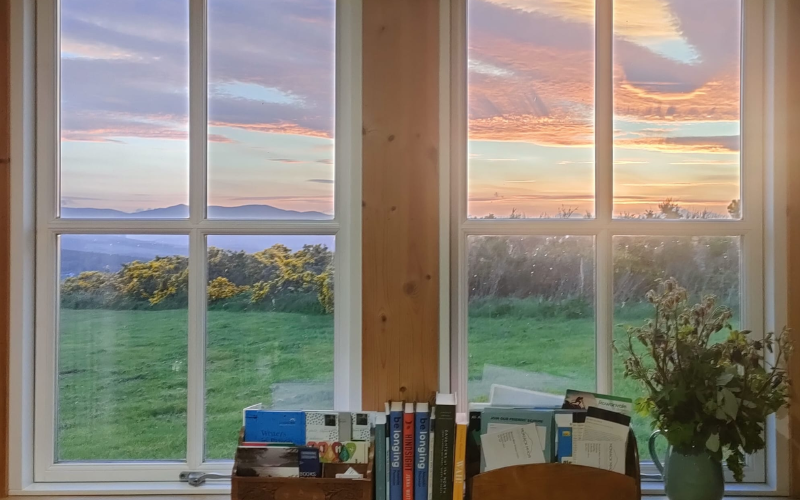
I love seeing people’s reactions on their first encounter with Moniack Mhor. Ostap Slyvynsky, our poet in residence from Ukraine, compared our Straw Bale Studio (affectionately known as “the hobbit house”), and the whole experience of being at Moniack Mhor, to being on a boat. “Here are the portholes, there is the wide horizon stretching out below us. Even the landscape is in waves, and here we are all together,” he said.

A unique and inspiring place to work

For me, the sociable nature of my job as Centre Manager is what drew me here in the first place. I had longed to go on a course at Moniack Mhor, and had occasionally seen jobs crop up, but since I didn’t have a driving licence, I was never able to apply. Then, after lockdown, I was working from home, yearning for a more sociable job and one connected to the world of books, when this opportunity popped up. I edged my way northwards from Edinburgh getting to know the wonderful bunch of people who work there. Six months later, I took the plunge from remote working and moved to the Highlands, where I grew up and where I never imagined returning.

I have worked at magazines and publishers, and organised literary events, but nothing quite prepares you for the intimacy and friendliness of Moniack Mhor. It took me some time to settle into a more public-facing role again, and now I love it.

“Working for Moniack Mhor is like trying to stuff an octopus into a wardrobe,” as our Director, Rachel Humphries, said recently. This image aptly describes the myriad challenges and sometimes bizarre nature of the job. I enjoy the hosting and looking-after-people elements of my job the most. Best of all is when a person has a problem and I need to solve it. One guest requested a weighted blanket, but, given our remote location, such things aren’t always easy to find, so I invented my own using a large cushion cover and some wood from the woodshed. She was delighted with it.

A place of extremes – from cosy kitchen to seasonal challenges

The kitchen is the heart of Moniack Mhor, where some of my favourite conversations with writers have taken place. Guests have described the nourishment that helps them get their writing done by stripping away all the hard work. We staff all share in the house tasks, including working in the kitchen. It has its quirks: the “cupboard of chaos” and “drawer of doom” meld into the mix of chatter, cakes and a feeling of delicious sociable warmth. The lunches are nothing short of joyous thanks to our talented cooks and the quality of our locally sourced food.

Moniack is a place of extremes. In winter, we pull the food delivery down the steep track on sledges. I have had to go out and rescue lost guests in the snow and the dark. I have been stuck in the snow myself and was lucky to have had the help of Graeme Macrae Burnet and other guests to push my tiny car up the hill.

The Monday night arrival meal is my favourite time of the week. Laughter and hubbub emanate from the dining room as the group get to know each other. People bond so much they often want to come back in the same group. I try to have lunch with guests and tutors as much as possible. Then, at the end of the week, we have to say goodbye and hope they will come back.

My only regret is that I didn’t come here as a guest before I worked here. But next month I am going on my first course at Moniack Mhor. I can’t wait to experience it from the other side, to burrow myself into the sofa by the fire, where I have rarely sat before. I will try my best to ignore the tentacles of my to do list reaching out to me, and I will write.


Claire Daly

Claire Daly is Centre Manager at Moniack Mhor, Scotland’s national writing centre. You can follow the centre on X (formerly Twitter), Facebook, Instagram and YouTube.


2023

Read more: Life at Moniack Mhor: a special haven for writers

How Publishing in Scotland is Going from Strength to Strength

How publishing in Scotland is going from strength to strength

Scotland is home to around 100 active publishing companies, varying greatly in size and focus. Structurally, our publishing reflects global industry trends: a large number of small independents, most established in the past five decades, which operate alongside offices of larger conglomerates. ‘Small’, however, should not be confused with ‘insignificant’ – Scotland has a thriving book trade, with its publishers and authors regularly receiving prestigious awards and international acclaim.

Over 2,000 books are published in Scotland per year, with 90 percent of our publishers also selling their titles overseas.

Global success for Scottish publishers

Scottish publishers have an increasingly global outlook, both in exporting their products and in welcoming writing from all over the world. Canongate, one of our largest trade publishers, is known for its excellent internationally-focused list that recently attracted two Booker Prize nominations in one year, for A Spell of Good Things by Ayọ̀bámi Adébáyọ̀ and The House of Doors by Tan Twan Eng. With its mission statement of ‘publishing in Scotland for the world’, Birlinn also works with an array of internationally acclaimed and award-winning authors like Alexander McCall Smith, Denise Mina and Jenni Fagan. There are also indies that focus on translated fiction: Charco Press is scooping up awards and nominations for its brilliant work in uncovering the best of contemporary Latin American literature, and Vagabond Voices publishes work translated from Estonian, Italian, Latvian, Swedish and more, calling itself ‘both Scottish and fervently European in its aims’.

Promoting national culture

While increasingly looking outside of Scotland, our publishers are also fundamental to sustaining and promoting our literary and linguistic heritage. Companies like Acair, Luath Press and Itchy Coo (an imprint of Black and White Publishing) publish acclaimed Scottish authors and celebrate the national languages, Gaelic and Scots, advocating for their inclusion in the Scottish curriculum. These (and many other) companies make an enormous contribution to Scotland’s understanding of itself and its past, ensuring that our distinct culture is recognised and represented.

Award-winning children’s publishing

Scotland is also known for its award-winning children’s publishing. Floris Books offers an array of titles for all ages, from the classics of Scottish literature to new authors discovered through its annual Kelpies Prize. Barrington Stoke produces accessible, dyslexia-friendly books that encourage every child to be a reader, and DC Thomson has been publishing its bestselling annuals (including Oor Wullie and Beano) for over 80 years. Independents such as Little Door Books or Cranachan Publishing have also been developing, establishing themselves as some of the most creative and exciting children’s publishers on the market. You can watch our recent documentary on the growth of children’s writing and publishing in Scotland, Forever Lands, here.

It’s not all about trade

Of course, Scottish publishing is not all trade – our specialist and academic companies, such as Witherby Publishing Group and Edinburgh University Press, are amongst the largest and most successful publishers in the country. Bright Red Publishing, the only independent educational publisher in Scotland, has been producing excellent resources for secondary students and teachers for the last 15 years. And Scottish publishing is not all independent – conglomerates like HarperCollins and Hachette have their offices in Scotland, making an important contribution to the health and diversity of our industry, while the trading arms of the national cultural institutions such as the National Galleries of Scotland or the Royal Botanic Gardens Edinburgh all have lively publishing programmes.

Publishing Scotland – championing the nation’s book industry

All of these publishers are members of Publishing Scotland – the network for trade, training, and development for the book publishing sector. Established in 1974 by a group of independent publishers, the organisation acts as the voice and network for Scottish publishing, developing and promoting the work of companies, organisations and individuals in the industry, as well as co-ordinating joint initiatives and partnership.

Some of our flagship activities include organising the largest book trade event in Scotland, the Scottish Book Trade Conference, facilitating international exchange through the International Publishing Fellowship, and promoting Scottish books through our Books from Scotland portal and New Books Scotland catalogues.

We also provide training in publishing skills, and have done so for nearly 30 years – our programme aims to make publishing training more widely accessible to publishing industry professionals working across all areas of the trade, both in Scotland and beyond. You can find out more about our courses here, follow us on LinkedIn and X (previously Twitter), and sign up to our training newsletter for regular updates.


Alice Piotrowska

Alice Piotrowska is Training and Digital Marketing Manager for Publishing Scotland.


2023

Read more: How Publishing in Scotland is Going from Strength to Strength

Freelancing in Fiction and Board Games

Freelancing in fiction and board games

Why fiction and board games?

My husband is a board-game designer in his spare time. For some years I had been proofreading his rules, prior to their submission to publishers, as well as proofreading his games for publishers, before going to print. At the time, I was seeking a flexible career, working from home, to fit in with my family.

I enjoyed the proofreading work, so decided to use my existing skills. In 2016 I completed the PTC Essential Proofreading course, gaining formal proofreading skills and an industry-recognised qualification. Initially, I specialised in proofreading for the board-game industry, using my previous experience. However, once my business was established, I expanded into copy-editing and proofreading fiction. Following further training in copy-editing and fiction editing, I now specialise in historical and fantasy/sci-fi/speculative fiction – my favourite genres. One of the great aspects of freelancing in publishing is that you can work on the subjects that interest you most, including your hobbies.

Getting started

Networking with my husband’s contacts in the board-game industry helped kickstart my career. Just one month after completing Essential Proofreading, I received paid work from my first client – who I still work with today! It then took a year or two to establish further clients.

My work in a nutshell

Copy-editing fiction requires a great deal of checking – including for accuracy and consistency of spelling, grammar, punctuation, syntax, formatting and page layout. I also check for consistency and logic of the story, carry out basic fact-checking and keep a detailed style sheet of editorial style, character names and place names. Editing historical fiction also involves checking for anachronisms.

Editing board games involves working on rulebooks, cards, box covers, boards and other written game components for publishers, and prototype rules for game designers pitching to publishers. I check spelling, grammar, punctuation, page layout, and that the graphics and images are correct. Consistency checking is important within each file and across all components, for example to ensure consistent use and styling of game terms.

Training – a vital confidence booster

Training gave me the confidence to set up my business and offer professional editing services. Despite having good spelling and grammar (vital for successful proofreading) and some proofreading experience, I learned so much more on the course. Having my work and assignments assessed by my personal tutor, and passing the course with merit, gave me the skills and knowledge to carry out proofreading work for clients – and the assurance that clients would feel confident working with me, knowing I have a proven qualification.

My training experience is on my website and listings, so clients can see what I’ve completed, and it endorses my credibility to potential clients.

What I enjoy about my role

I enjoy the variety of genres of fiction and themes of board games I work on. Every project is different in terms of length and the level of work involved. It’s rewarding to work methodically through fiction manuscripts and to keep details of the story in a spreadsheet, to help check for inconsistencies. I also love completing style sheets! There’s something satisfying about listing editorial style choices, character names, place names, and so on, knowing it will help the author to keep consistency in that book – and later books if they write a series.

It’s a privilege to be asked to copy-edit or proofread someone’s book or game that they’ve spent months or years working on, and I feel a great sense of achievement sending back the completed work with suggestions for improving the accuracy and consistency.

Keeping up to date with industry developments

Commitment to regular Continuing Professional Development keeps my skills up to date and ensures I keep track of developments and trends in the publishing industry. This includes:

  • membership of the Chartered Institute of Editing and Proofreading, which allows me to attend local group and fiction group meetings and their editorial conferences – offering an excellent way to explore new skills and ideas
  • reading books, guides and blogs, and staying up to speed on social media
  • ongoing training, including taking courses and watching fiction writers’ webinars in different genres.

My top tips for aspiring fiction or board-game editors

My top advice is to do some proofreading training first, followed by copy-editing if you wish to. Join an editorial society, for course discounts, access to a wealth of information, and to meet other editors for mutual support.

There are some excellent courses and books available to ensure you gain the necessary specialist skills for fiction editing.

If you’re considering a career in board games, attend conventions to connect with publishers and designers, find out about the latest game releases and new trends, and even play games to gain useful experience.


Rachael Mortimer

Rachael Mortimer is a freelance copy-editor and proofreader.

You can visit her website and follow her on Twitter and LinkedIn.


2023

Read more: Freelancing in Fiction and Board Games

Writing and Career Advice from Blueprint for All

Writing and career advice from Blueprint for All

Blueprint for All, formerly known as the Stephen Lawrence Charitable Trust, was founded in 1998. It believes that talent exists everywhere, but equal opportunities do not. Its mission is to create an inclusive society in which talent is respected and nurtured, regardless of race, ethnicity or background, and where anyone can thrive.

The charity achieves this through working with organisations and businesses to recognise and harness the advantages of a diverse workforce, and with schools, universities, community groups and employers, to inspire and enable young people aged 13–30 to pursue and succeed in the career of their choice. It also empowers communities across the UK to tackle inequality and discrimination for long-term, sustainable change.

Its programmes are organised into four key strands: careers, communities, society and a recently launched digital platform, 'My Blueprint for All'. These programmes encompass workshops, events, bursaries and mentoring opportunities, further supplemented by its social enterprise consultancy, Building Inclusive Futures, which sits alongside it. Many of these programmes focus on literary careers, including those in writing and publishing.

The Publishing Training Centre is partnering with Blueprint for All to offer those registered with the organisation free access to the e-learning module An introduction to publishing, until 31 December 2023.

Breaking into writing ­– and top tips

Eve Froude, the charity’s Communications and Content Manager, and Adjj Owusu-Darko, My Blueprint for All's Career Ambassador, share their experience and advice to those wanting to break into books, whether as a published author or working within the industry.

“The art of writing has always captivated the imagination of readers, marvelling at the ability of authors to craft literary masterpieces. One lesson I've learned through my own writing journey is the importance of taking that first step,” explains Eve. “Whether it's tapping away at a keyboard or scribbling ideas in a notepad, the act of beginning is far more rewarding than remaining in a state of creative inertia.

Writing, as an art form, holds immense potential for mastery, accessible to all who possess the right knowledge and dedication. While some may be naturally gifted writers, the journey of becoming a skilled writer often starts with short-form writing.”

The focus of Adjj’s work and writing is “to empower individuals to achieve their dream careers, whilst also creating valuable resources to support their professional endeavours. These resources range from how to write a CV to handling job rejection without taking it personally. All are designed to give you a deeper understanding of how to navigate your professional career and provide open access knowledge to people from diverse backgrounds who may not have had this opportunity before.

I’ve had a lot of experience landing jobs I didn’t quite feel qualified for, cold pitching and hearing nothing back,” says Adjj. “But from these experiences, I’ve also been lucky enough to have multiple wins along the way due to developing my writing skillset. Knowing your own personal experience and how it can help others is a surefire way to get good at writing. Here are some of my top tips:

  • Just start: embark on your writing journey by capturing your thoughts and letting ideas flow freely.
  • Ignore the mistakes: remember that the first draft is not meant to be flawless. Embrace imperfections and refine your work later.
  • Write from familiarity: draw upon personal experiences to enhance authenticity and boost your confidence as a writer.
  • Seek feedback: share your work with others, as writing ultimately serves a broader audience.”

Overcoming common hurdles

“The writing journey is not without its challenges, especially for those who come from disadvantaged backgrounds, who may be aspiring to work in the publishing industry”, advises Eve. “Here are three common hurdles that individuals face when starting or progressing in their careers:

  • Limited access to opportunities: many aspiring writers from disadvantaged backgrounds often lack the connections and resources necessary to enter the publishing industry. They may face barriers when seeking internships, work experience, or mentorship.
  • Financial constraints: pursuing a career in writing, whether as an author or within the publishing industry, can be financially demanding. Costs associated with training, courses, and attending industry events can create significant barriers for those with limited financial means.
  • Lack of representation: the publishing industry, like many others, has historically struggled with diversity and inclusion. Individuals from underrepresented backgrounds often face challenges in finding role models and mentors who share their experiences and can guide them in their careers.

Building a fulfilling writing career takes time and exploration to find the right stories and opportunities, but it is undoubtedly within reach. I stand as living proof of the possibilities that lie ahead!

To access further creative opportunities, check out My Blueprint for All, and be part of a network of like-minded people looking to expand their skillsets.

Good luck!”


Blueprint for All

For more information about Blueprint for All, visit their website

You can follow them on TwitterFacebookInstagram             or LinkedIn.


2023

Read more: Writing and Career Advice from Blueprint for All

Realise Your Full Potential in Publishing with LDN Apprenticeships

Realise your full potential in publishing with LDN Apprenticeships

LDN Apprenticeships are rated an ‘outstanding’ apprenticeship training provider by Ofsted. We have been delivering apprenticeships for over 12 years, across a range of business sectors, and focus on creating opportunities for diverse talent to reach its full potential.

In 2019, after discussions with The Publishers Association, we launched the Publishing Assistant apprenticeship to help varied talent succeed in the sector. Since the first cohort, we’ve collaborated with some brilliant publishers – including Bloomsbury Publishing and Pearson – to open fantastic opportunities for new talent to enter the UK publishing industry.

Learn while you work: the purpose of apprenticeships

Apprenticeships are designed to support learning whilst working, allowing apprentices to apply their knowledge, skills and behaviours immediately in their day-to-day role. They are an effective way to embed knowledge in a structured and practical way.

In publishing, they produce well-rounded professionals who understand how their role fits into the wider publishing process, and how that process works end-to-end. Publishing apprentices have a commercial and practical understanding of publishing and often perform above the standard expected of them.

Apprentices are given time during their contracted hours to do their apprenticeship work. Monthly one-to-one coaching sessions support them throughout, and monthly live sessions allow them to embed and share their knowledge with fellow apprentices, whilst developing a wider network. There are also quarterly masterclasses where industry experts share their knowledge, and twice-yearly development days which offer a valuable opportunity for apprentices to meet and network.

Attract and retain talent

Apprenticeships are a great way to attract and retain non-traditional talent into the publishing sector. The structured learning and support, alongside the network they develop, means that apprentices achieve a 95% positive progression rate. As a result, apprentices either stay with their employer or find a role at another publishing, or related, company. Alumni cover a broad spectrum of roles, including digital editors, production editors, account managers, assistant editors, assistant project managers and publishing executives.

It is also a great way to support employees who have moved from a non-publishing to a publishing role, so they can learn on the job. 

The majority of apprentices stay in the sector after completing their apprenticeship and have already started to progress within the industry. Many apprentices on other programmes have also progressed to senior positions – including the current education minister, Gillian Keegan, and the CEO of London Gatwick Airport, Stewart Wingate.

The Publishing Assistant programme

The 15-month long publishing assistant apprenticeship provides a broad introduction to the publishing industry, from editorial and design through production and legal to marketing and sales. It covers:

  • Getting to know the publishing industry, including the publishing process and systems, the commercial aspect of publishing and metadata.
  • Editorial processes and skills, editorial design principles and production.
  • Digital publishing.
  • Rights and law.
  • Sales and marketing, including digital marketing.

After 12 months, the apprentice undergoes an End Point Assessment (EPA). In the EPA, the apprentice’s portfolio is reviewed, the apprentice delivers a presentation and has a professional discussion. If successful, they are awarded a pass or a distinction.

The ideal preparation for a successful career in publishing

The breadth of the LDN publishing apprenticeship gives our apprentices a real advantage over candidates with 2–3 years’ experience and allows them to discover the area of publishing they are most comfortable with.

As one of our line managers said of the scheme,

I think this is an excellent experience for apprentices. They gain an incredible wealth of knowledge of the whole industry, work with the best people and it really sets them up to interview well and thrive in roles in publishing.“ Lucy Brown, Commissioning Editor, Bloomsbury Publishing

and from Tom Avery – Publishing Director at The Tate,

Aki has almost single-handedly produced a publication proposal for one of Britain’s brightest young artists, in collaboration with colleagues at Tate and with regional galleries and an international cultural foundation. The book should be one of our key titles for 2023, and it’s largely thanks to Aki’s hard work and tenacity.


Marcus Simmons

Marcus Simmons is Sales Director at LDN Apprenticeships. Visit the LDN Apprenticeship website to find out more about the Publishing Assistant programme.

Follow LDN Apprenticeships on Instagram, LinkedIn and Twitter.


2023

Read more: Realise Your Full Potential in Publishing with LDN Apprenticeships